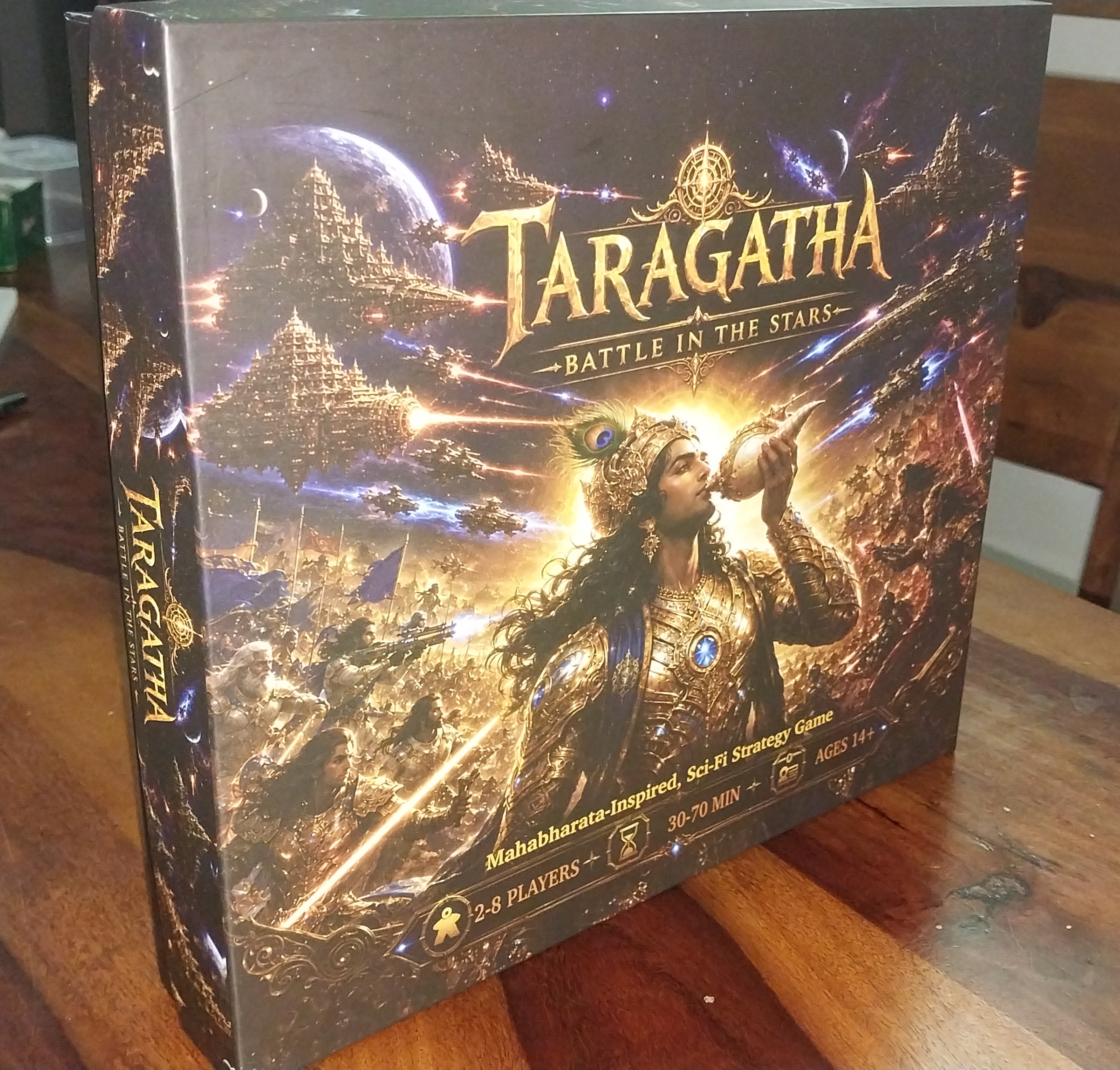
Rule book
Taragatha: BIS Basic Rules
| Term | Meaning/Game Effects |
| General | Turn = One player’s play. A 5-turn effect lasts for 5 of that player’s own turns.2d6 = Short form for rolling two six-sided dice and adding their results together.Round = One full cycle in which every player takes a turn. |
| Rishi | A monk who helps you do Tapasyas and gives Dharma and Varas, as written in Rishi card. Dharma: Righteousness points (resource), needed for tasks like using Astras (buy cards)Vara means blessing (game bonuses). A player can earn a Rishi’s Vara only once in a game. |
| Tapasya | A spiritual undertaking done with the help of a Rishi. Get Dharma points and Varas.Take a Rishi Card from the top of the deck, roll 2d6 > Tapasya Success Requirement (TSR) If Roll 2d6>TSR – Tapasya Success Points (TSP), get Dharma and Vara, else only Dharma.1 Tapasya Success Point (TSP) = 50 Dharma points. TSR – TSP cannot be less than 4.TSR = 5 for Maharishi, 7 for Brahmarishi and 8 for DevarishiIf Tapasya is successful, the player gets a Tapasya token, but before your next turn, if you are attacked and lose, then Tapasya fails, and Vara is reversed. Any TSP token used in Tapasya has to be returned after use, irrespective of success or failure. Maximum 4 TSP can be held by a player at a time.After doing the 3rd Tapasya, the player must complete the next round without being defeated to achieve Moksha and win the game. |
| Astras | Are Single Use, Buy with Dharma points earned through Tapasya. |
| Combat | Attack any player on your turn by deploying any 1 Vimana (warrior) + Astra (1 or max 3). Defender must defend with their any 1 Vimana (warrior) + 1 Astra (1 or max 3).Then, combat happens with 2d6 Attacker roll first, followed by 2d6 Defender roll. Effective Combat Power (ECP) = 1 Warrior/Vimana card CP + Astras’ CP + 2d6 (Combat roll)Victory Margin (VM) = Higher ECP – Lesser ECPVM = 0, combat drawn, both Vimanas safe, VM>0, Lower ECP player’s Vimana destroyed.The winner takes half the losing player’s owned Dharma points (max 100 Dharma).A player cannot be attacked more than 2 times in one round. A warrior can only be used once per round, Chosen Character is exempt from this rule.Defeated Warrior/Vimana cannot be used again. If your chosen character dies in combat, then you lose the game |
Turn Action Sequence
| Step 1: Purchase Astras (1 or more) and assign Astras to Vimanas, assignment can be done or changed only on purchase phase of your turn. You can also purchase Tapasya Success |
| Step 2: Take one main action: Attack one player, or perform one Tapasya and resolve consequences |
Detailed Rule Book For Game Gurus
1. Setup
- The game supports 2-4 players.
- Choose a player as Game Guru who has read the full ruleset and can clarify any doubts for other players.
- Pick which Mahabharata you will play as, each character has special abilities that can significantly impact game outcome. Each character’s special bonuses and powers are described in their character card.
- If more than one player wants the same character, resolve by 2d6; the highest wins.
- Give each player their chosen character card and that character’s warrior card.
- Shuffle the remaining warrior cards. Deal each player 2 warrior cards. Draupadi is not a combatant, and does not have a corresponding warrior card so Draupadi players will get 3 warrior cards.
- Each player should get 1 warrior with a Carrier or Super Carrier Vimana, 1 warrior with Destroyer or Battleship Vimana, and 1 warrior with an Attack fighter-Frigate class Vimana.
- Shuffle the Rishi deck. After end of Tapasya, used Rishi cards go to the bottom of the deck.
- Give starting Dharma points to each player, Starting Dharma = 50 + Character Bonus
- Give all players a basic rule card.
- Starting player: the highest 2d6 starts.
2. Turn Sequence
- Perform turn action sequence as described in Basic Rules card.
- Astra Purchase and loading must be completed before you attack or perform Tapasya. Astras bought on your turn may be used that same turn.
3. Dharma and Purchases
- Dharma is earned through Tapasya.
- Dharma can be used to purchase astras.
- Tapasya Success Points are also bought using Dharma points.
4. Astras
- You may buy only Astras that are available in the collection. If all copies are already held by other players, you cannot buy that Astra.
- Astras are stored “inside” or with a Vimana. Astra assignment can only be changed during purchase phase of your turn.
- Tapasya Success Points are single use and cannot be reused. They cannot
- Any Astra used in a combat must be returned to the collection after that combat.
5. Warriors, Defeat, and Elimination
- Each player’s team consists of the chosen character plus the 2 warriors/VImana they received at setup.
- A dead chosen character cannot be revived.
- If your chosen character loses combat and dies, you are eliminated from the game.
- If, after combat, you have 0 available warriors, you are eliminated from the game. An eliminated player returns Astras and Dharma points and leaves the game.
5. Combat
- Dead warriors cannot fight.
- Combat involving a Player’s Chosen Character is called Character combat.
- 5a. Combat Casual Gamer Mode
- Step 1: Attacker declares attack on Defender and plays their chosen Warrior/Vimana card + CP Boost Card
- Step 2: The defending player chooses a Defender Warrior/Vimana card + CP Boost Card.
- Step 3: Winner and loser of combat is determined as described in the Basic Rules Card.
- Step 4: Final combat result is applied, which is a draw or death.
- 5a. Combat – Strategy Gamer Mode
- Carrier can use other ships’ powers as it is a command ship and carries other ships with it. E.g. Ati-Maharathi ranks can use the power of the Tamisra-class ship (if it’s the light ship you possess) to disable the enemy capital ship’s special powers and Astra.
- Ati-Maharathi rank ship can use the powers of Padatik and Ashvarohi rank ships. MahaMaharathi rank supercarriers can use the powers of ArdhaRathi and Rathi class ships.
- Combat is resolved in this order:
- Step 1: Attacker declares attack on Defender and plays their chosen Warrior/Vimana card along with an Astra loaded on the Vimana (optional)
- Step 2: The defending player chooses a Defender Warrior/Vimana card, but can only use an Astra previously loaded on the defending Vimana.
- Step 3: Special Power of Attacker’s Vimana is applied first, and then SP defender’s Vimana is applied if attacker SP didn’t disable defender Vimana SP.
- Step 4: The winner and loser of the combat is determined as described in the Basic Rules Card.
- Step 5: Final combat result is applied, which is draw or death.
6. Tapasya
- You can become a Shishya of a Rishi in your turn and do Tapasya by rolling dice or 2d6.
- If 2d6>Tapasya Success Requirement – Tapasya Success Points, you successfully complete the Tapasya.
- If you are attacked and defeated before your next turn after a successful Tapasya, then the Tapasya fails, and the Vara earned is reversed.
- A player can pursue only one Tapasya on his turn.
- After Tapasya, the Rishi card must be returned to the bottom of the deck on the same turn. Use corresponding tokens to track which Tapasya you got and how many Moksha points you have earned.
8. Character Powers
- Character powers and bonuses of each character are described in their respective character card.
- 9. Victory Condition
- When all other players have been eliminated from the game either by their 3 warriors/vimanas being destroyed in combat or their chosen character being killed in combat, then the last player remaining becomes the Victor.
- Player can win by Completing 3 Tapasyas and thus achieving Moksha.