Taragatha: Battle in the Stars — A Strategic Beginner’s Guide
How to Play Battle in the Stars
A strategic guide to Dharma, Tapasya, Astras, Rishis, Varas, Curses, Warriors, character powers, fleet combinations, and the major playstyles that shape every game.
The Core Idea
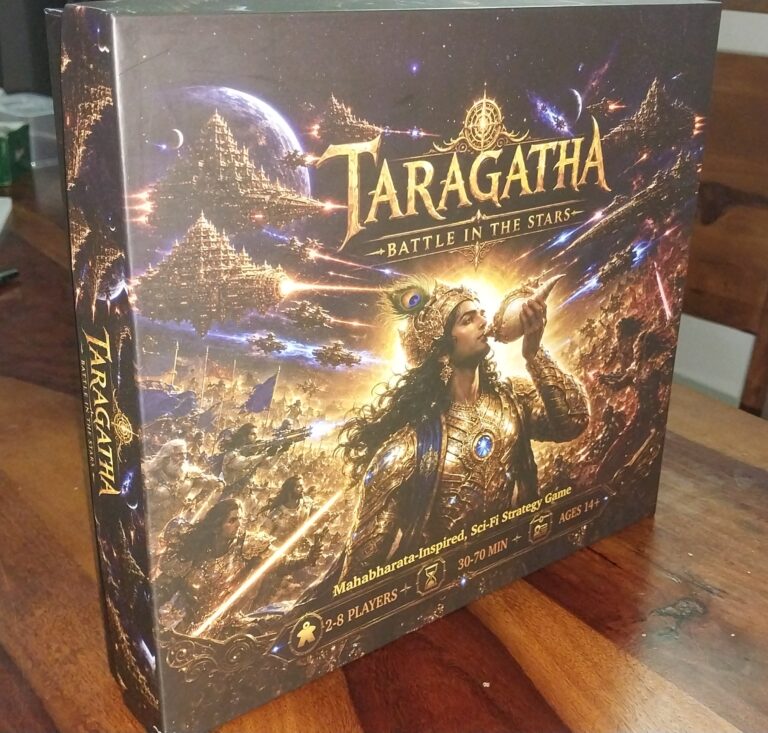
Battle in the Stars is a fast, aggressive, mythic sci-fi card game where players command Mahabharata-inspired warriors aboard powerful Vimanas, gather Dharma through Tapasya, unleash Astras in combat, and race toward either military victory or spiritual victory through Moksha.
The heart of the game is one hard choice every turn: should you grow stronger through Tapasya, or should you attack before your rivals become too powerful? Players who fight too early may run out of Astras and warriors. Players who meditate too long may become rich, vulnerable targets.
How You Win
Military Victory
Eliminate all other players by destroying their available warriors/Vimanas or by killing their chosen character in character combat.
Moksha Victory
Complete 3 Tapasyas and then survive the next round without being defeated to achieve Moksha.
This creates two competing victory clocks. A combat-heavy player wants to remove threats quickly. A Tapasya-heavy player wants to complete spiritual progress while surviving enemy retaliation.
Setup and Starting Position
Each player chooses a character such as Arjuna, Karna, Bhishma, Duryodhana, Draupadi, Yudhishthira, Ulupi, Shakuni, Ashvatthama, and others. Your chosen character is not just one of your warriors. It is your identity in the game. If your chosen character dies in combat, you are eliminated.
Character Card
Your chosen Mahabharata-inspired character gives you special bonuses and strategic direction.
Warrior/Vimana Cards
You begin with your character’s warrior card plus additional warriors. Draupadi is non-combatant.
Starting Dharma
You begin with 40 Dharma plus any character-specific bonus or penalty.
A balanced team normally contains one major carrier or supercarrier, one heavy ship such as a destroyer or battleship, and one lighter ship such as an attack ship, frigate, corvette, or stealth ship.
Turn Structure
Step 1: Purchase Phase
Buy Astras using Dharma and assign them to Vimanas. Astra assignment matters because it can only be changed during this phase.
Step 2: Main Action
Choose one main action: attack another player or perform Tapasya.
Combat Explained
Combat is deadly, direct, and easy to resolve. The attacker chooses a warrior/Vimana and may use loaded Astras. The defender chooses a defending warrior/Vimana and may use Astras available to that defending Vimana.
If both sides tie, the combat is a draw and both Vimanas survive. If one side has higher Effective Combat Power, the lower side’s warrior/Vimana is destroyed. The winner also takes half the loser’s Dharma, up to a maximum of 100 Dharma.
| Static Advantage Before Dice | Approximate Combat Meaning |
|---|---|
| +0 | Uncertain fight. Dice matter heavily. |
| +1 to +2 | Slight advantage, but still risky for character combat. |
| +3 to +4 | Strong advantage. Usually worth considering if the target matters. |
| +5 or more | Dominant advantage. Ideal for decisive strikes. |
Astras: The Combat Economy
Astras are single-use combat cards bought with Dharma. Levels 1–7 are purchasable in the current game structure, while the highest Astras are generally obtained through Varas.
| Astra Level | Combat Power | Cost | Strategic Role |
|---|---|---|---|
| Level 1 | +1 CP | 20 Dharma | Cheap filler, useful for small edges. |
| Level 2 | +2 CP | 20 Dharma | Excellent early efficiency. |
| Level 3 | +3 CP | 40 Dharma | Good mid-level pressure. |
| Level 4 | +4 CP | 60 Dharma | Reliable combat swing. |
| Level 5 | +5 CP | 80 Dharma | Strong attack or defense tool. |
| Level 6 | +6 CP | 100 Dharma | Major strike weapon. |
| Level 7 | +7 CP | 120 Dharma | Premium battle-winning Astra. |
The most efficient early Astra is Level 2 because it gives +2 CP for only 20 Dharma. Higher Astras are less efficient per Dharma, but they are better for burst damage because each combat allows only limited Astra use.
Tapasya, Rishis, Varas, and Curses
Tapasya is how players earn Dharma, Varas, and Moksha progress. On a Tapasya turn, you draw a Rishi card and roll 2d6 against that Rishi’s Tapasya Success Requirement.
| Rishi Rank | Normal TSR | Typical Dharma | Strategic Meaning |
|---|---|---|---|
| Maharishi | 5 | 40 Dharma | Easy Tapasya, lower reward. |
| Brahmarishi | 7 | 80 Dharma | Balanced risk and reward. |
| Devarishi | 8 | 120 Dharma | Harder Tapasya, powerful reward. |
A successful Tapasya grants the Rishi’s Vara. Failure still gives Dharma, but not the Vara. Players may buy Tapasya Success Points with Dharma to reduce the required number, though the target cannot go below 4.
Varas can grant CP boosts, powerful Astras, extra Dharma, enemy Astra theft, enemy warrior defection, and other game-changing benefits. Curses can punish players by removing Dharma, giving away Astras, reducing CP, or weakening their position.
Major Playstyles
1. The Astra Blitz Player
Converts Dharma into Astras quickly and attacks before opponents complete multiple Tapasyas. Best suited for Arjuna, Abhimanyu, Ashvatthama, Karna, Bhimasena, Bhishma, and Dronacharya.
2. The Tapasya Engine Player
Prioritizes Dharma, Varas, and Moksha progress. Best suited for Draupadi and Yudhishthira. This style must survive the vulnerable window after successful Tapasya.
3. The Control Player
Interferes with enemy Astras, CP, and combat plans. Strong with Ulupi, Nakula, Sahadeva, Shakuni, Duryodhana, and Ghatokacha.
4. The Attrition Player
Forces enemies to waste Astras and survives longer than the table expects. Strong with Duryodhana, Bhishma, Dronacharya, Nakula, Sahadeva, and Yudhishthira.
5. The Assassin Player
Searches for one lethal opening against a chosen character. Strong with Arjuna, Abhimanyu, Ashvatthama, Karna, Bhimasena, and Dhrishtadyumna in the right matchup.
6. The Political Survivor
Avoids becoming the table’s main target while others exhaust themselves. This style works especially well in 3–4 player games.
Character Strategy and Counters
Arjuna
How to play: Use his high CP, powerful Vimana, starting Dharma advantage, and reroll to threaten decisive character combat.
How to counter: Do not fight Arjuna in clean character combat while his reroll is unused. Attack his support warriors and exhaust his Astras first.
Abhimanyu
How to play: Build enough Dharma to support his strong character-combat reroll. He needs Astra backing to become truly lethal.
How to counter: Pressure his economy. Without Astras, his reroll is strong but not unbeatable.
Ashvatthama
How to play: Use Raudra Roop to turn uncertain fights into high-probability kills.
How to counter: Bait out the bonus in a lower-value combat before exposing your chosen character.
Bhimasena
How to play: Hunt Duryodhana and Duhshasana when present. Against others, use him as a strong battleship brawler.
How to counter: Avoid giving him his preferred matchup. Use side warriors and defensive Astras.
Bhishma
How to play: Use him as a stable high-CP anchor who is difficult to attack and dangerous when armed.
How to counter: Avoid frontal combat unless you have Astra superiority or denial. Drain resources first.
Dhrishtadyumna
How to play: Build economy and preserve Astras until the Dronacharya matchup appears.
How to counter: Dronacharya should avoid direct character combat until Dhrishtadyumna’s best Astras are spent.
Draupadi
How to play: Focus on Tapasya, Varas, and Moksha. Maintain defensive Astras and strong warrior protection.
How to counter: Attack immediately after she completes Tapasya. Do not let her quietly accumulate Moksha progress.
Dronacharya
How to play: Use his high CP and supercarrier presence to dominate fair fights.
How to counter: Dhrishtadyumna is the natural counter. Otherwise, drain his resources before attacking directly.
Duryodhana
How to play: Force opponents to overcommit. His Victory Margin reduction can turn narrow losses into draws.
How to counter: Do not attack with a narrow edge. Bhimasena is his natural predator.
Duhshasana
How to play: Avoid early character combat. Use underhanded tactics and Astras to create surprise reversals.
How to counter: Attack his non-character warriors first. Bhimasena is especially dangerous for him.
Ghatokacha
How to play: Use Rakshasa illusions to punish opponents who rely on raw CP in character combat.
How to counter: Attack with side warriors, use Astra denial, or wait until his trick is unavailable.
Karna
How to play: Target Pandava characters when present. Against others, rely on Astras and Varas to create combat advantage.
How to counter: Pandava players should avoid direct character combat unless they have clear Astra superiority.
Nakula and Sahadeva
How to play: Punish opponents who rely on one major Astra. Their Astra-ignoring power is strongest against burst attacks.
How to counter: Use multiple smaller Astras or bait out the ignore effect before the real strike.
Shakuni
How to play: Play politically, avoid fair fights, and use his enemy CP reduction to make attacks against him inefficient.
How to counter: Pressure him early before he fixes his Dharma disadvantage.
Ulupi
How to play: Wait for opponents to overcommit with a premium Astra, then use Naga illusions to neutralize their burst.
How to counter: Avoid relying on one huge Astra. Use distributed pressure or attack her support warriors.
Yudhishthira
How to play: Build a Tapasya engine and aim for Moksha while maintaining enough defense to survive attacks.
How to counter: Attack during the vulnerable window after successful Tapasya. Do not allow him to complete three Tapasyas uncontested.
Warrior and Vimana Combo Principles
The strongest fleet is not always the one with the highest total CP. A good fleet needs three things: a safe character, an expendable attacker, and a defensive answer.
High-CP Character + Strong Side Warrior
Use the side warrior for normal combat and preserve your chosen character for decisive battles.
Carrier + Light Ship Utility
In Strategy Gamer Mode, carriers and supercarriers can benefit from smaller ship powers, making light ships tactically valuable.
Tapasya Character + Durable Defenders
Draupadi or Yudhishthira with strong defensive warriors can become a serious Moksha threat.
Low-CP characters with disruptive powers should avoid direct character combat until their Astras, Varas, or matchups create favorable conditions.
Practical Strategy Tips
- Do not hoard too much Dharma. It can be stolen after combat.
- Do not spend all Dharma immediately. You still need flexibility during the Purchase Phase.
- Load Astras defensively as well as offensively. The wrong Astra on the wrong Vimana may be useless.
- Attack players who just completed Tapasya. That is when a successful defeat can reverse their Vara.
- Bait once-per-round powers. Make Arjuna, Ashvatthama, Duryodhana, Ulupi, Nakula, or Sahadeva spend their key ability before the real strike.
- Protect your chosen character. Losing a side warrior is painful. Losing your chosen character ends your game.
The Strategic Philosophy
Battle in the Stars rewards timing more than brute force. Astras are powerful, but single-use. Tapasya is rewarding, but exposes you. Chosen characters are deadly, but their death means elimination.
Attack too early, and you may run out of weapons. Wait too long, and another player may achieve Moksha. Spend too little, and your warriors die. Spend too much, and your next battle becomes impossible.
It is: “If I win this fight, will I still be strong enough to survive what comes next?”