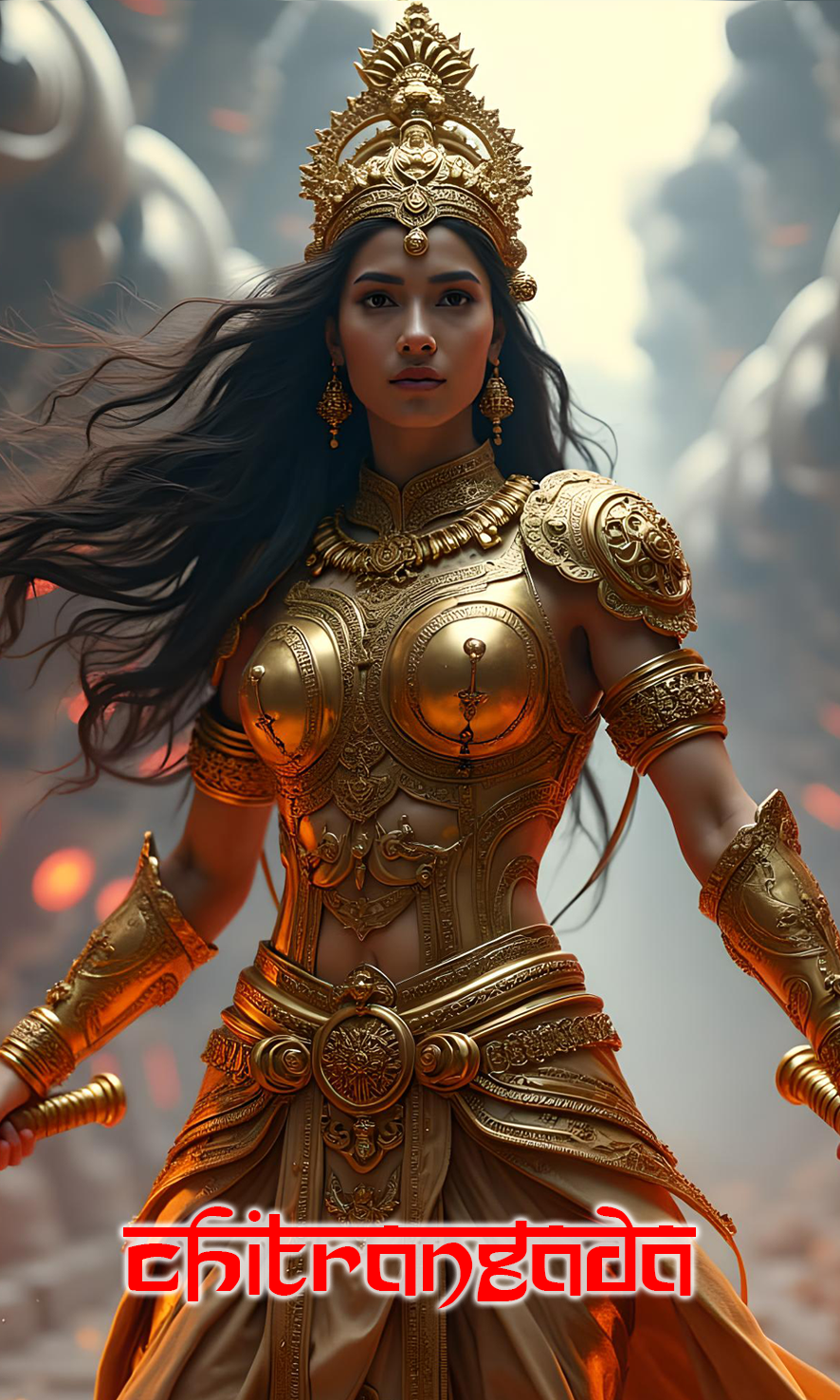
Chitrangada
Chitrangada had a warrior rank of Rathi. Affiliation: Pandava. Chitrāngadā was the warrior princess of Manipura. She was the only heir of king Chitravahana and one of Arjuna’s consorts. She had a son named Babhruvahana with him. Later, Babhruvahana unknowingly killed his father but was revived by Ulupi, Chitrāngadā’s friend, and co-wife.
Quote
happened that Arjuna beheld her in her father’s palace roving at pleasure. Beholding the handsome daughter of Chitravahana, Arjuna desired to possess her. Going unto the king (her father), he represented unto him what he sought. He said. ‘Give away unto me thy daughter, O king! I am an illustrious Kshatriya’s son.’ Hearing this, the king asked him, ‘Whose son art thou?’ Arjuna replied, ‘I am Dhananjaya, the son of Pandu and Kunti.’ The king, hearing this, spoke unto him these words in sweet accents, ‘There was in our race a king of the name of Prabhanjana, who was childless. To obtain a child, he underwent severe ascetic penances. By his severe asceticism, O Partha, he gratified that god of gods,
Mahadeva, the husband of Uma, that supreme Lord holding (the mighty bow called) Pinaka. The illustrious Lord granted him the boon that each successive descendant of his race should have one child only. In consequence of that boon only one child is born unto every successive descendant of this race. All my ancestors (one after another) had each a male child. I, however, have only a daughter to perpetuate my race. But, O bull amongst men, I ever look upon this daughter of mine as my son. O bull of Bharata’s race, I have duly made her a Putrika. Therefore, one amongst the sons that may be begotten upon her by thee, O Bharata, shall be the perpetuator of my race. That son is the dower for which I may give away my daughter. O son of Pandu, if them choosest, thou canst take her upon this understanding.’Hearing these words of the king, Arjuna accepted them all, saying, ‘So be it.’” – The Mahabharata, Book 1: Adi Parva: Arjuna-vanavasa Parva: Section CCXVII
“Chitrangada endued with celestial beauty, said unto her these words, ‘Behold. O Ulupi, our ever-victorious husband slain in battle, through thee, by my son of tender years. Art thou conversant with the practices of the respectable? Art thou a wife devoted to thy lord? It is through thy deed that thy husband is laid low, slain in battle. If Dhananjaya hath offended against thee in every respect, do thou forgive him I solicit thee, do thou revive that hero. O righteous lady, thou art conversant with piety.” – The Mahabharata, Book 14: Aswamedha Parva: Anugita Parva: Section LXXX