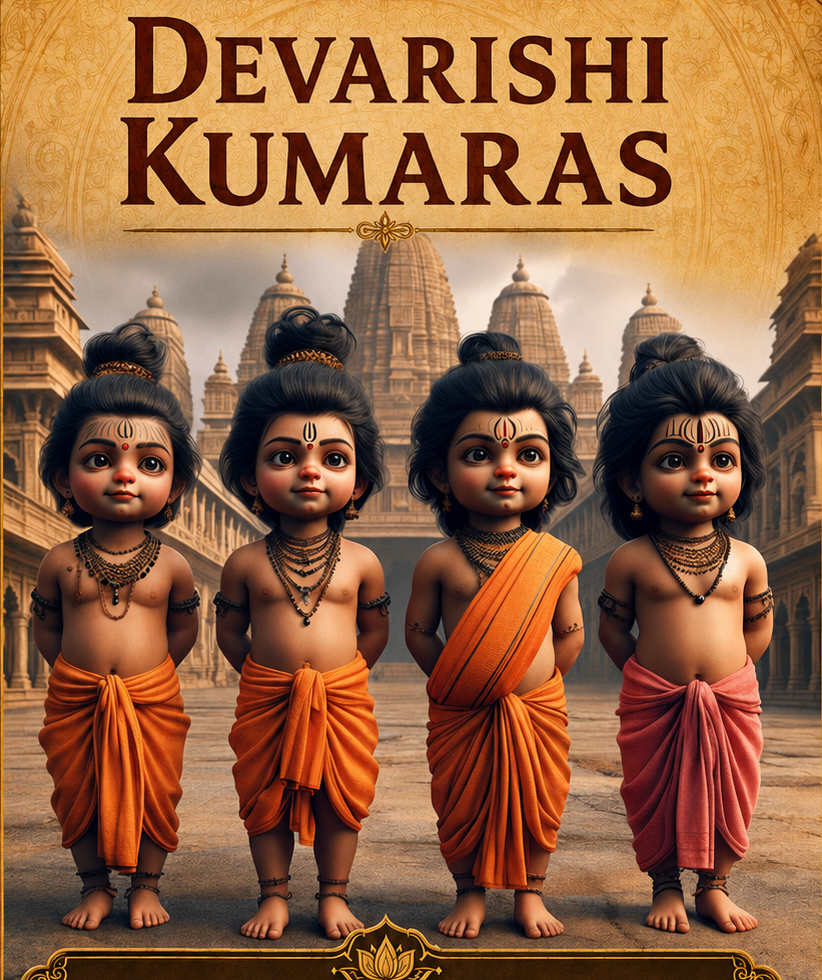
Devarishi Kumaras
Other names: Sanaka; Sanandana; Sanatana; Sanatkumara; Four Kumaras. The four child-sages are mind-born sons of Brahma and are famed for celibacy, detachment, and pursuit of spiritual knowledge. Vaishnava tradition remembers them as self-realized sages who received knowledge from Brahma and taught devotion and wisdom.
“It hath been sung by Sanatkumara and by the highsouled Vyasa, and it is in the Vedas also, that one should, O king, go to Prithudaka, with subdued soul. O son of Kuru race, there is no tirtha which is superior to Prithudaka. Without doubt, that tirtha is purifying, holy and sin-destroying. O best of men, it hath been said by learned persons that men, however sinful, by bathing in Prithudaka, go to heaven.” – The Mahabharata, Book 3: Vana Parva: Tirtha-yatra Parva: Section LXXXIII
“Sanatkumara uttered the following, fraught with grave import, upon the pre-eminent greatness of Vishnu unto the intelligent chief of the Danavas, ‘Listen, O Daitya, to everything about the greatness of Vishnu. Know, O scorcher of foes, that the entire universe rests on Vishnu. O thou of mighty arms, it is He who creates all creatures mobile and immobile. In course of Time it is He, again, who withdraws all things and in Time it is He who once more casts them forth from Himself. Into Hari all things merge at the universal destruction and from Him all things again come forth. Men possessed of scriptural lore cannot obtain him by such lore. Nor can He be obtained by Penances, nor by Sacrifices. The only means by which He can be attained is by restraining the Senses. Nor that sacrifices are entirely useless towards such an end. For one, by relying upon both external and internal acts, and upon one’s own mind, can purify (them) by one’s own understanding. By such means, one succeeds in enjoying infinity in the world. As a goldsmith purifies the dross of his metal by repeatedly casting it into the fire with very persistent efforts of his own, after the same manner Jiva succeeds in cleaning himself by his course through hundreds of births.” – The Mahabharata, Book 12: Santi Parva: Mokshadharma Parva: Section CCLXXX
“’Narada said, In days of yore the illustrious Sanatkumara had said these words unto certain Rishis of cleansed souls that had repaired to him for enquiring after the truth. There is no eye like that of knowledge. There is no penance like renunciation. Abstention from sinful acts, steady practice of righteousness, good conduct, the due observance of all religious duties,–these constitute the highest good. Having obtained the status of humanity which is fraught with sorrow, he that becomes attached to it, becomes stupefied: such a man never succeeds in emancipating himself from sorrow. Attachment (to things of the world) is an indication of sorrow. The understanding of person that is attached to worldly things becomes more and more enmeshed in the net of stupefaction. The man who becomes enmeshed in the net of stupefaction attains to sorrow, both here and hereafter. One should, by every means in one’s power, restrain both desire and wrath if one seeks to achieve what is for one’s good.” – The Mahabharata, Book 12: Santi Parva: Section CCCXXX