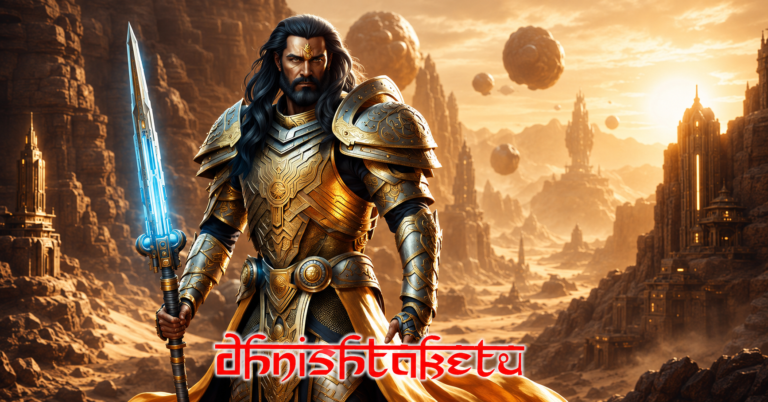

Brahmarishi Vishvamitra
Other names: Visvamitra; Kausika; Viswamitra; Kaushika. Son of Gadhi or Gathin, he was born a Kshatriya king and, through intense tapasya, attained Brahmana-hood and the status of Brahmarishi. His story is closely associated with Vasistha, Menaka, and the ideal that ascetic power can transform worldly status.
“His (Vishwamitra) mouth is like unto a blazing fire; the pupils of his eyes are like the Sun and the Moon; his tongue is like unto Yama himself. How shall, O chief of the celestials, a woman like me even touch him? At the thought of his prowess Yama, Soma, the great Rishis, the Saddhyas, the Viswas, Valakhilyas, are terrified! How can a woman like me gaze at him without alarm? Commanded, however, by thee, O king of the celestials, I shall somehow approach that Rishi. But, O chief of the gods, devise thou some plan whereby protected by thee, I may safely move about that Rishi. I think that when I begin to play before the Rishi, Marut (the god of wind) had better go there and rob me of my dress, and Manmatha (the god of love) had also, at thy command, better help me then. Let also Marut on that occasion bear thither fragrance from the woods to tempt the Rishi.’ Saying this and seeing that all she had spoken about had been duly provided, Menaka went to the retreat of the great Kausika.'” – The Mahabharata, Book 1: Adi Parva: Sambhava Parva: Section LXXI
“In this foremost of tirthas of the Sarasvati, O king, he began to emaciate his own body by means of vows and fasts with fixed resolve. He made water and air and (the fallen) leaves of trees his food. He slept on the bare ground, and observed other vows (enjoined for ascetics). The gods made repeated attempts for impeding him in the observance of his vows. His heart, however, never swerved from the vows (he had proposed to himself). Then, having practised diverse kinds of austerities with great devotion, the son of Gadhi became like the Sun himself in effulgence. The boon-giving Grandsire, of great energy, resolved to grant Vishvamitra, when he had become endued with ascetic merit, the boon the latter desired. The boon that Vishvamitra solicited was that he should be permitted to become a Brahmana. Brahma the Grandsire of all the worlds, said unto him, ‘So be it.’ Having by his austere penances acquired the status of Brahmanhood, the illustrious Vishvamitra, after the attainment of his wish, wandered over the whole Earth like a celestial.”
“In ancient times, in order to test Viswamitra, who was then engaged in ascetic austerities Dharma personally came to him, having assumed the form of the Rishi, Vasishtha. Thus assuming, O Bharata, the form of the one of the seven Rishis, and feigning himself hungry and desirous of eating, he came, O king, to the hermitage of Kausika. Thereupon, Viswamitra struck with awe, began to cook Charu (which was a preparation of rice and milk)…
Viswamitra succeeded in approaching him with the Charu he had cooked and which was still steaming. ‘I have already dined; wait here,’–were the words that the holy one said. And having said that the holy one went away. And thereupon, the illustrious Viswamitra, O king, waited there. And after a hundred years had passed away, Dharma, again assuming the form of Vasishtha, came to Kausika from desire of eating. And beholding the great Rishi Viswamitra, who was endued with high wisdom, standing there with that food on his head, himself subsisting all the while on air, Dharma accepted that food which was still warm and fresh. And having eaten that food, the deva said,–Gratified am I, O regenerate Rishi. And saying this, he went away. And at those words of Dharma, Viswamitra divested of Kshatriyahood because endued with the status of a Brahmana and was filled with delight” – The Mahabharata, Book 5: Udyoga Parva: Bhagwat Yana Parva: Section CVI