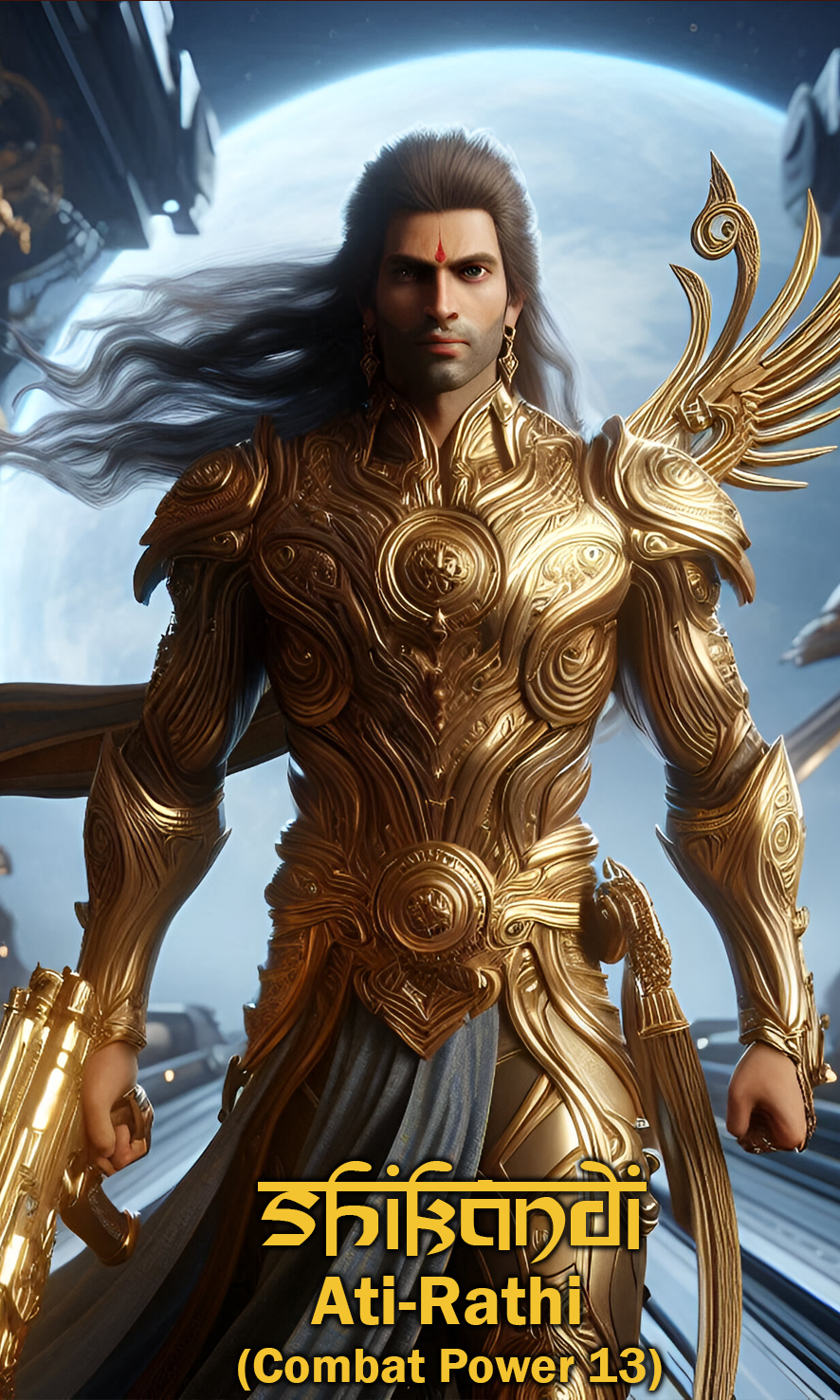
Shikandi
Shikandi had a warrior rank of Ati-Rathi. Other names: Sikhandin. Affiliation: Pandava. Shikhandi was born as a baby girl, named “Shikhandini,” to Drupada, the king of Panchala, and his wife. Later she changed her sex and took the name Shikhandi. He fought in the Kurukshetra war for the Pandavas along with his father Drupada and brother Dhristadyumna. He was Kashi’s Amba in previous birth.
Quote
“Bhishma said, ‘That subjugator of hostile cities, Sikhandin, the son of the king of the Panchalas, is, O king, in my judgment, one of the foremost of Yudhishthira’s Rathas. Having divested himself on his former sex, he will fight in battle and earn great fame- The Mahabharata, Book 5: Udyoga Parva: Uluka Dutagamana Parva: Section CLXXII
“Entering that mansion, Sikhandini, the daughter of Drupada, O king, began to reduce herself by foregoing all food for many days. Thereupon, the Yaksha named Sthuna, who was endued with kindness, showed himself unto her. And he enquired of her, saying, ‘For what object is this endeavour of thine? I will accomplish it, tell me without delay!’ Thus asked, the maiden answered him, repeatedly saying, ‘Thou art unable to accomplish it!’ The Guhyaka, however, rejoined, without a moment’s delay, saying, ‘Accomplish it I will! I am a follower of the Lord of treasures, I can, O princess, grant boons! I will grant thee even that which cannot be given! Tell me what thou hast to say!’ Thus assured, Sikhandini represented in detail everything that had happened, unto that chief of Yakshas called Sthunakarna. And she said, ‘My father, O Yaksha, will soon meet with destruction. The ruler of the Dasarnakas marcheth against him in rage.” – The Mahabharata, Book 5: Udyoga Parva: Uluka Dutagamana Parva: Section CXCIV
“’O Blessed lady, I will certainly do what thou wishest! Listen, however, to the condition I make. For a certain period I will give thee my manhood. Thou must, however, come back to me in due time. Pledge thyself to do so! Possessed of immense power, I am a ranger of the skies, wandering at my pleasure, and capable of accomplishing whatever I intend. Through my grace, save the city and thy kinsmen wholly! I will bear thy womanhood, O princess! Pledge thy truth to me, I will do what is agreeable to thee!’ Thus addressed, Sikhandini said unto him, ‘O holy one of excellent vows, I will give thee back thy manhood! O wanderer of the night, bear thou my womanhood for a short time! After the ruler of the Dasarnakas who is cased in a golden mail will have departed (from my city) I will once more become a maiden and thou wilt become a man!’ p. 369 “Bhishma continued, ‘Having said this (unto each other), they both. O king, made a covenant, and imparted unto each other’s body their sexes. And the Yaksha Sthuna, O Bharata, became a female, while Sikhandini obtained the blazing form of the Yaksha. Then, O king, Sikhandini of Panchala’s race, having obtained manhood, entered his city in great joy and approached his father. And he represented unto Drupada everything that had happened. And Drupada, bearing it all became highly glad. And along with his wife the king recollected the words of Maheswara. And he forthwith sent, O king, messenger unto the ruler of the Dasarnakas, saying, ‘This my child is a male. Let it be believed by thee!’ The king of the Dasarnakas meanwhile, filled with sorrow and grief, suddenly approached Drupada, the ruler of the Panchalas. And arrived at Kampilya, the Dasarnaka king despatched, after paying him proper honours, an envoy who was one of the foremost of those conversant with the Vedas. And he addressed the envoy, saying, ‘Instructed by me, O messenger, say unto that worst of kings the ruler of the Panchalas, these words,–viz., O thou of wicked understanding, having selected my daughter as a wife for one who is thy daughter, thou shalt today, without doubt, behold the fruit of that act of deception.’ Thus addressed and despatched by him, O best of kings, the Brahmana set out for Drupada’s city as Dasarnaka’s envoy. And having arrived at the city, the priest went unto Drupada’s presence. The king of the Panchalas then, with Sikhandin, offered the envoy, O king, a cow and honey. The Brahmana, however, without accepting that worship, said unto him these words that had been communicated through him by the brave ruler of the Dasarnakas who was cased in a golden mail. And he said, ‘O thou of vile behaviours, I have been deceived by thee through thy daughter (as the means)! I will exterminate thee with thy counsellors and sons and kinsmen!’ Having, in the midst of his counsellors, been made by that priest to hear those words fraught with censure and uttered by the ruler of the Dasarnakas, king Drupada then, O chief of Bharata’s race, assuming a mild behaviour from motives of friendship, ‘said, The reply to these words of my brother that thou hast said unto me, O Brahmana, will be carried to that monarch by my envoy!’ And king Drupada then, sent unto the high-souled Hiranyavarman a Brahmana learned in the Vedas as his envoy. And that envoy, going unto king Hiranyavarman, the ruler of the Dasarnakas, said unto him, ‘O monarch, the word that Drupada had entrusted him with.’ And he said, ‘This my child is really a male. Let it be made clear by means of witness! Somebody has spoken falsely to thee. That should not be believed!’ Then the king of the Dasarnakas, having heard the words of Drupada, was filled with sorrow and despatched a number of young ladies of great beauty for ascertaining whether Sikhandin was a male or female. Despatched by him, those ladies, having ascertained (the truth) joyfully told the king of the Dasarnakas everything, viz., that Sikhandin, O chief of the Kurus, was a powerful person of the masculine sex. Hearing that testimony, the ruler p. 370 of the Dasarnakas was filled with great joy, and wending then unto his brother Drupada, passed a few days with him in joy. And the king, rejoiced as he was, gave unto Sikhandin much wealth, many elephants and steeds and kine. And worshipped by Drupada (as long as he stayed), the Dasarnaka king then departed, having rebuked his daughter. And after king Hiranyavarman, the ruler of the Dasarnakas had departed in joy and with his anger quelled, Sikhandin began to rejoice exceedingly. The Mahabharata, Book 5: Udyoga Parva: Uluka Dutagamana Parva: Section CXCV