Yudhishthira
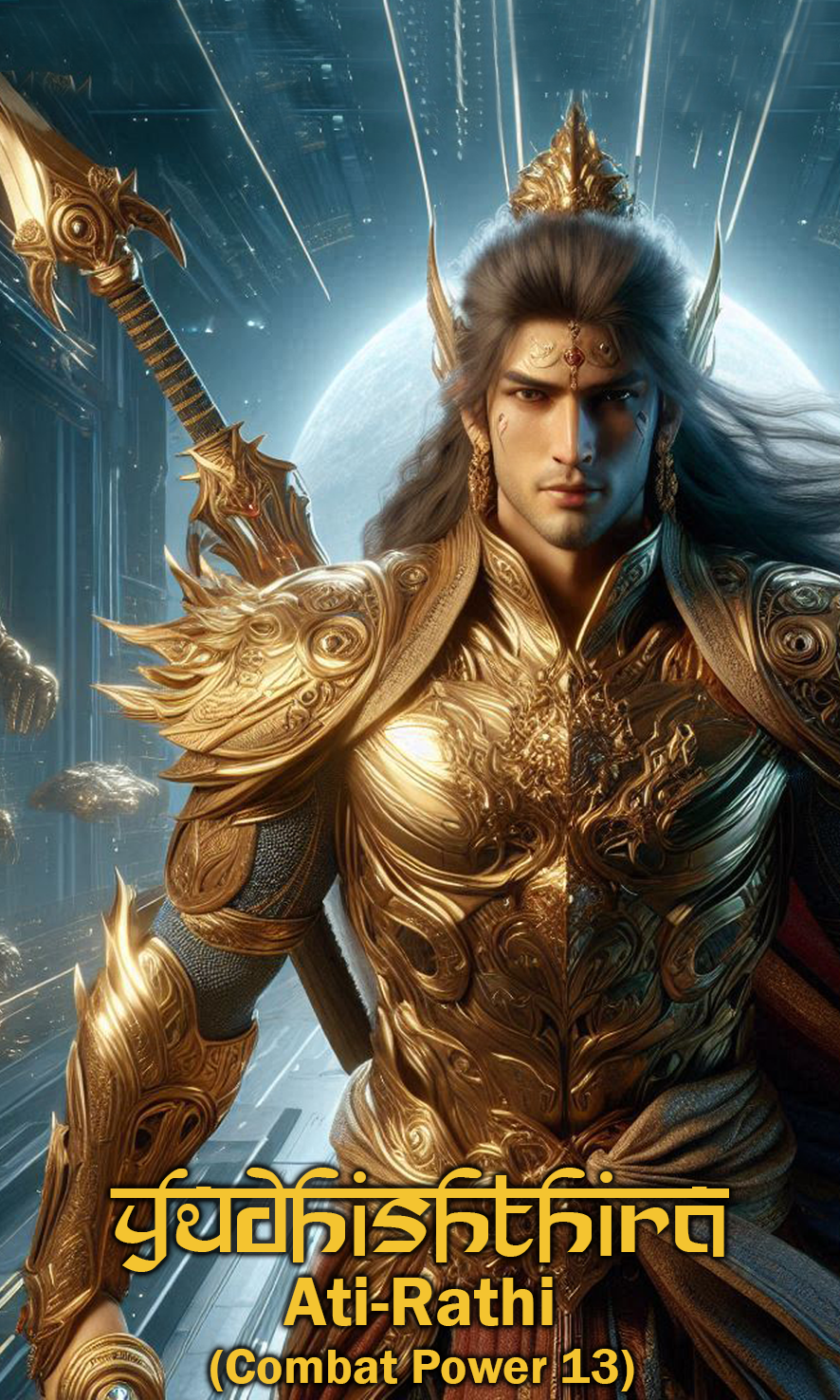
Yudhishthira had a warrior rank of Ati-Rathi. Affiliation: Pandava. Yudhishtira was the first among the five Pandavas and was blessed by death god Yama to Pandu and Kunti. He became the king of Indraprastha and later of Hastinapura (Kuru). He was the leader of the successful Pandava side in the Kurukshetra War. At the end of the epic, he ascended to heaven. He was also blessed with the spiritual vision of second sight by a celestial Rishi as a boon. Yudhistira was only panadava who survived hell and later went to suryaloka.
Quote
“The king himself, son of Pandu and Kunti, is a mighty Ratha. Without doubt, O sire, be will glide along the field of battle like a blazing fire;”- The Mahabharata, Book 5: Udyoga Parva: Uluka Dutagamana Parva: Section CLXX
“Then Yudhishthira, excited with rage, rushed against the ruler of the Madras, himself urging his steeds white as ivory and fleet as thought. We then saw something that was wonderful in Yudhishthira, the son of Kunti, for though very mild and soft, he then became exceedingly fierce. With eyes opened wide and body trembling in rage, the son of Kunti cut off hostile warriors in hundreds and thousands by means of his sharp shafts. Those amongst the soldiers against whom the eldest Pandava proceeded, were overthrown by him, O king, like mountain summits riven with thunder. Felling cars with steeds and drivers and standards and throwing down car-warriors in large numbers, Yudhishthira, without any assistance, began to sport there like a mighty wind destroying masses of clouds…” – The Mahabharata, Book 9: Shalya Parva: Section 16
“The illustrious Shalya then, cutting off the golden coats of mail of both Bhima and king Yudhishthira with nine arrows, pierced the arms of both of them. With another razor-faced arrow endued with the splendour of fire or the sun, he then cut off the bow of Yudhishthira. At this time Kripa, with six arrows, slew the king’s driver who thereupon fell down in front of the car. The ruler of the Madras then slew with four shafts the four steeds of Yudhishthira. Having slain the steeds of the king, the high-souled Shalya then began to slay the troops of the royal son of Dharma. When the (Pandava) king had been brought to that plight, the illustrious Bhimasena, quickly cutting off the bow of the Madra king with an arrow of great impetuosity, deeply pierced the king himself with a couple of arrows. With another arrow he severed the head of Shalya’s driver from his trunk, the middle of which was encased in mail. Exceedingly excited with rage, Bhimasena next slew, without a moment’s delay, the four steeds also of his foe…
Beholding the ruler of the Madras before him, he rushed towards that foe with great impetuosity. Recollecting the words of Govinda, he quickly set his heart on the destruction of Shalya. Indeed, king Yudhishthira the just, staying on his steedless and driverless car, desired to take up a dart. Beholding that feat of Shalya and reflecting upon the fact that the hero who had been allotted to him as his share still remained unslain, the son of Pandu firmly set his heart upon accomplishing that which Indra’s younger brother had counselled him to achieve. King Yudhishthira the just, took up a dart whose handle was adorned with gold and gems and whose effulgence was as bright as that of gold. Rolling his eyes that were wide open, he cast his glances on the ruler of the Madras, his heart filled with rage. Thus looked at, O god among men, by that king of cleansed soul and sins all washed away, the ruler of the Madras was not reduced to ashes. This appeared to us to be exceedingly wonderful, O monarch. The illustrious chief of the Kurus then hurled with great force at the king of the Madras that blazing dart of beautiful and fierce handle and effulgent with gems and corals. All the Kauravas beheld that blazing dart emitting sparks of fire as it coursed through the welkin after having been hurled with great force, even like a large meteor falling from the skies at the end of the Yuga. King Yudhishthira the just, in that battle, carefully hurled that dart which resembled kala-ratri (the Death Night) armed with the fatal noose or the foster-mother of fearful aspect of Yama himself, and which like the Brahmana’s curse, was incapable of being baffled. Carefully the sons of Pandu had always worshipped that weapon with perfumes and garlands and foremost of seats and the best kinds of viands and drinks. That weapon seemed to blaze like Samvartaka-fire and was as fierce as a rite performed according to the Atharvan of Agnirasa. Created by Tvashtri (the celestial artificer) for the use of Ishana, it was a consumer of the life-breaths and the bodies of all foes. It was capable of destroying by its force the Earth and the welkin and all the receptacles of water and creatures of every kind. Adorned with bells and banners and gems and diamonds and decked with stones of lapis lazuli and equipped with a golden handle, Tvashtri himself had forged it with great care after having observed many vows. Unerringly fatal, it was destructive of all haters of Brahma. Having carefully inspired it with many fierce mantras, and endued it with terrible velocity by the exercise of great might and great care, king Yudhishthira hurled it along the best of tracks for the destruction of the ruler of the Madras. Saying in a loud voice the words, “Thou art slain, O wretch!” the king hurled it, even as Rudra had, in days of yore, shot his shaft for the destruction of the asura Andhaka, stretching forth his strong (right) arm graced with a beautiful hand, and apparently dancing in wrath.
Shalya, however, roared aloud and endeavoured to catch that excellent dart of irresistible energy hurled by Yudhishthira with all his might, even as a fire leaps forth for catching a jet of clarified butter poured over it. Piercing through his very vitals and his fair and broad chest, that dart entered the Earth as easily as it would enter any water without the slightest resistance and bearing away (with it) the world-wide fame of the king (of the Madras). Covered with the blood that issued from his nostrils and eyes and ears and mouth, and that which flowed from his wound, he then looked like the Krauncha mountain of gigantic size when it was pierced by Skanda. His armour having been cut off by that descendant of Kuru’s race, the illustrious Shalya, strong as Indra’s elephant, stretching his arms, fell down on the Earth, like a mountain summit riven by thunder. Stretching his arms, the ruler of the Madras fell down on the Earth, with face directed towards king Yudhishthira the just, like a tall banner erected to the honour of Indra falling down on the ground.
” – The Mahabharata, Book 9: Shalya Parva: Section 17