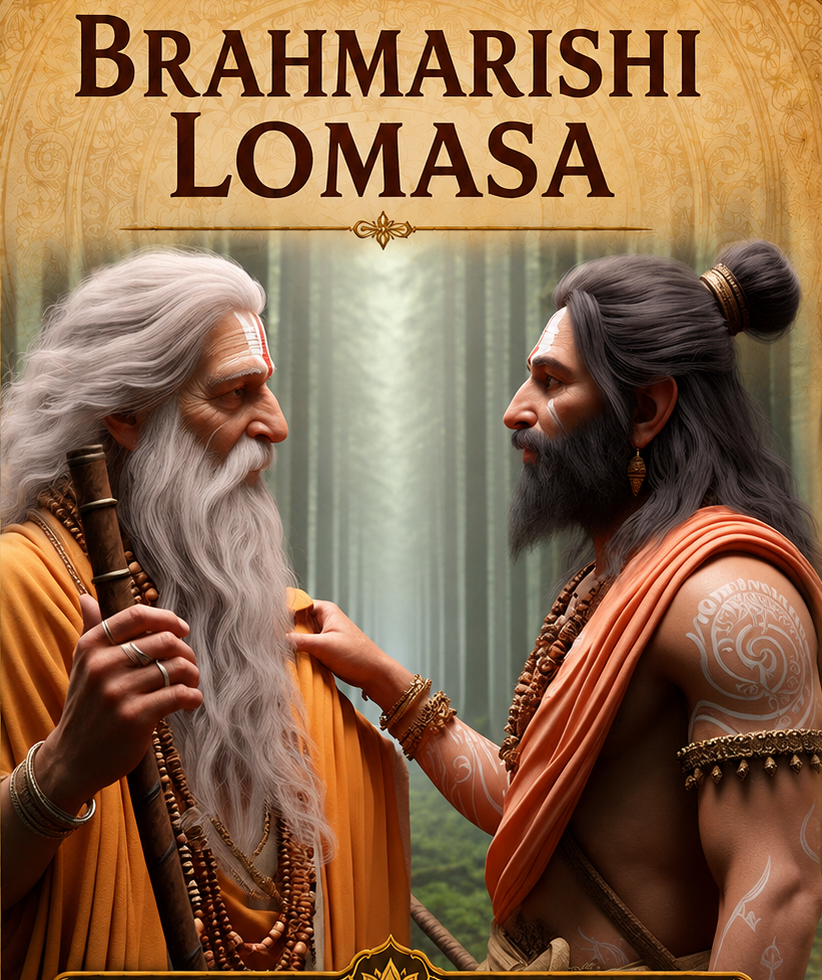
Brahmarishi Lomasa

Other names: Lomaśa; Lomasha. A celestial sage who came from the heavens to the Pandavas during exile, carrying news connected with Arjuna’s stay in Indra’s realm. He guided Yudhishthira and his brothers through sacred tirthas, making him a central figure in the Mahabharata’s pilgrimage narratives.

“Vaisampayana said, “One day, the great Rishi Lomasa in course of his wanderings, went to the abode of Indra, desirous of beholding the lord of the celestials. And the great Muni, having approached the chief of the gods, bowed to him respectfully. And he beheld the son of Pandu occupying half of the seat of Vasava… Go thou at my request to earth. Thou wilt behold the brave Yudhishthira living in the woods of Kamyaka. And for me tell thou the virtuous Yudhishthira of unbaffled prowess in battle, that he should not be anxious on account of Phalguna, for that hero will return to earth a thorough master of weapons, for without sanctified prowess of arms, and without skill in weapons, he would not be able to encounter Bhishma and Drona and others in battle. Thou wilt also represent unto Yudhishthira that the illustrious and mighty-armed Gudakesa, having obtained weapons, hath also mastered the science of celestial dancing and music both instrumental and vocal. And thou wilt also tell him, O king of men, O slayer of foes, thyself also, accompanied by all thy brothers, should see the various sacred shrines. For having bathed in different sacred waters, thou wilt be cleansed from thy sins, and the fever of thy heart will abate. And then thou wilt be able to enjoy thy kingdom, happy in the thought that thy sins have been washed off. And, O foremost of Brahmanas, endued with ascetic power, it behoveth thee also to protect Yudhishthira during his wandering over the earth. Fierce Rakshasas ever live in mountain fastnesses and rugged steppes. Protect thou the king from those cannibals.’” – The Mahabharata, Book 3: Vana Parva: Indralokagamana Parva: Section XLVII
Similar Posts

  • Maharishi Veda

    Other names: Rishi Veda. One of the three disciples of Ayoda-Dhaumya, alongside Aruni and Upamanyu. In the Mahabharata, he patiently endured hardship while serving his preceptor, gained knowledge through that discipline, later entered household life, and became the teacher of Uttanka. “Then Veda the other disciple of Ayoda-Dhaumya was called. His preceptor once addressed him,…

  • |

    Devarishi Asita Devala

    Other names: Asita; Devala; Asita-Devala. A sage associated with the Moksha and Yoga teachings of Jaigishavya in the Mahabharata. After witnessing Jaigishavya’s yogic powers, he sought instruction in the path of emancipation and became linked with teachings on detachment, truth, and spiritual discipline. “The highly blessed Devala then reflected upon the power of Jaigishavya and…

  • |

    Devarishi Pulastya

    Other names: Paulastya. One of Brahma’s mind-born Prajapatis and a Saptarishi of the first Manvantara. He is remembered as a transmitter of Purana knowledge, receiving the Vishnu Purana from Brahma and passing it to Parasara, and as the father of Vishravas, making him the ancestor of Kubera, Ravana, Kumbhakarna, and Vibhishana. “O tiger among kings,…

  • Maharishi Charusirsha

    Other names: Charuśīrṣa; Alamvana’s son. A compassionate sage described in the Mahabharata as the son of Alamvana and a dear friend of Sakra/Indra. He performed severe penance at Gokarna for a hundred years and received from Sarva/Shiva the boon of one hundred long-lived, righteous sons. “After this, the Rishi named Charusirsha, that dear friend of…

  • |

    Brahmarishi Jaratkaru

    Other names: Jaratkāru. An austere sage whose ancestors required him to continue the lineage. He married the serpent-woman Jaratkaru/Manasa, sister of Vasuki, and became the father of Astika, whose birth was destined to save the Nagas from Janamejaya’s serpent sacrifice. “The ancestors said, ‘We are Rishis of rigid vows, called Yayavaras. We are sinking low…

Leave a Reply

Your email address will not be published. Required fields are marked *