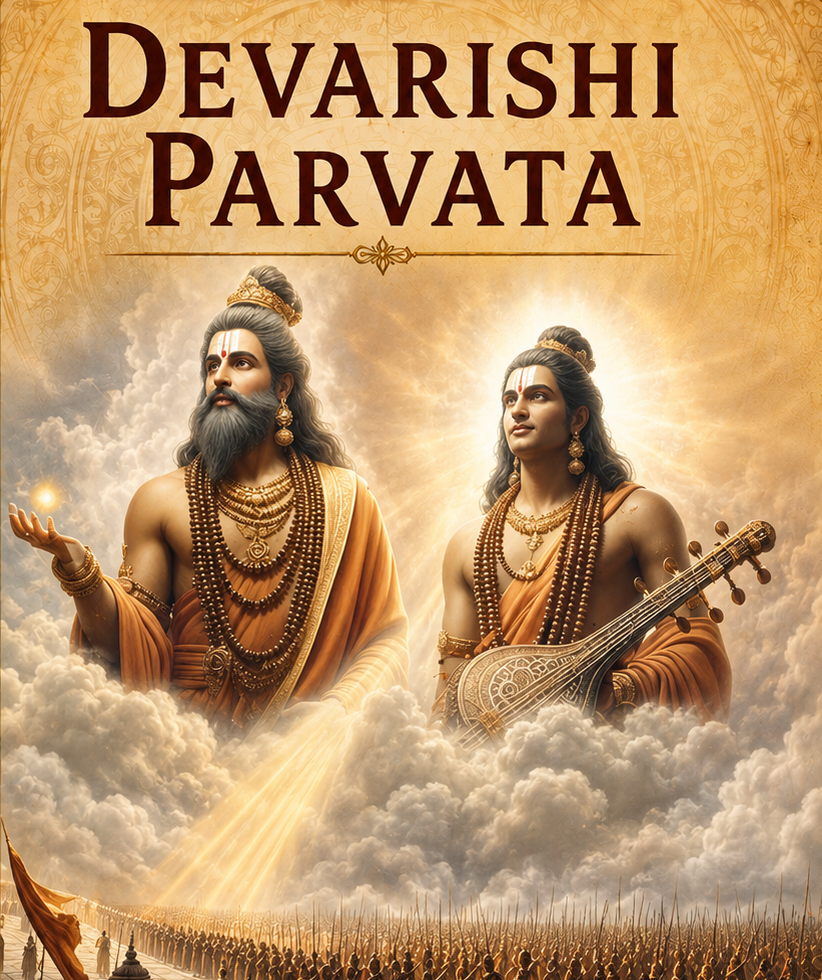
Devarishi Parvata
|

Devarishi Parvata

Other names: Parvata Muni. A Devarishi closely associated with Narada in Purana and Mahabharata traditions. Stories of Parvata often involve pilgrimage, curses, and royal courts, especially narratives in which he and Narada appear together as divine wandering sages.

Sanjaya said, ‘During the progress of that fierce and terrible battle, when the world was enveloped with darkness and dust, O king, the combatants, as they stood on the field, could not see one another. Those foremost of Kshatriyas fought with each other, guided by conjectures and the personal and other names (they uttered). And during the progress, O lord, of that terrible carnage of car-warriors and elephants and steeds and foot-soldiers, those heroes, viz., Drona and Karna and Kripa, and Bhima and Prishata’s son and Satwata, afflicted one another and the troops of either party, O bull of Bharata’s race. The combatants of both armies, oppressed all around by those foremost of car-warriors, during the hour of darkness, fled away on all sides. Indeed, the warriors, broke and fled away in all directions with hearts perfectly cheerless. And as they fled away in all directions, they underwent a great carnage. Thousands of foremost car-warriors also, O king, slaughtered one another in that battle. Unable to see anything in the dark, the combatants became deprived of their senses. All this was the result of the evil counsels of thy son. Indeed, at that hour when the world was enveloped in darkness, all creatures, O Bharata, including even the foremost of warriors, overcome with panic, were deprived of their senses in that battle…
For Duryodhana’s sake, many such were seen to come from Narada and Parvata in especial, lighting up that darkness. The (Kaurava) army then, disposed in compact array, looked resplendent, on that night with the light of those lamps, the costly ornaments (on the persons of combatants),” – The Mahabharata, Book 7: Drona Parva: Ghatotkacha-badha Parva: Section CLXII
Similar Posts

  • |

    Brahmarishi Markandeya

    Other names: Markendeya; Mārkaṇḍeya. A long-lived sage and great devotee of Shiva and Vishnu, traditionally the son of Mrikandu. Shiva is said to have rescued him from Yama, and later narratives remember him as the sage who witnessed the cosmic dissolution and received profound visions of divine reality. “Thus fifteen years passed by, when sage…

  • |

    Maharishi Ne

    Other names: Ne Muni; Nemi. A legendary sage connected with the sacred history of Nepal. Nepalese chronicle traditions describe Ne Muni as the protector, or pāla, of the land; the name Nepal is explained in this tradition as the land protected by Ne, and he is also linked with the founding of an early ruling…

  • Devarishi Jaigishavya

    Other names: Jaigīṣavya. A yogic ascetic associated with Asita Devala in the Mahabharata. After Devala witnessed his extraordinary yogic reach, Jaigishavya instructed him in the path of Moksha, Yoga, and equanimity; tradition also places him among sages meditating in Brahma’s assembly. “Then Devala, beholding the power derived through Yoga of Jaigishavya’s penances, reflected upon it…

  • |

    Brahmarishi Dhaumya

    Other names: Ayodaumya; Ayodhaumya; Ayoda-Dhaumya. A revered preceptor connected with the Pandavas, serving as their priest and spiritual guide. In the Mahabharata he is also the guru of Aruni, Upamanyu, and Veda, whose trials are classic examples of guru-bhakti and discipline. “The high-souled Dhaumya, acquainted with the true meaning of the Vedas and every rule…

  • |

    Brahmarishi Ashtavakra

    Other names: Aṣṭāvakra. Son of Kahoda/Kahola and Sujata, daughter of Uddalaka. While still in the womb he corrected his father’s Vedic recitation and was cursed to be born bent in eight places; later he defeated Vandi at King Janaka’s court, freed his father, and became associated with the Ashtavakra Gita. Then Ashtavakra said, ‘One is…

  • Maharishi Vibhandaka

    Other names: Vibhāṇḍaka. Son of Kashyapa and father of Rishyasringa. His son’s extraordinary birth through a deer and his isolated upbringing in the forest form one of the Mahabharata’s most unusual origin stories, emphasizing austerity, restraint, and the power of tapas. “When the great saint Vibhandaka should enquire of you about his son, ye must…

Leave a Reply

Your email address will not be published. Required fields are marked *