Brahmarishi Ashtavakra
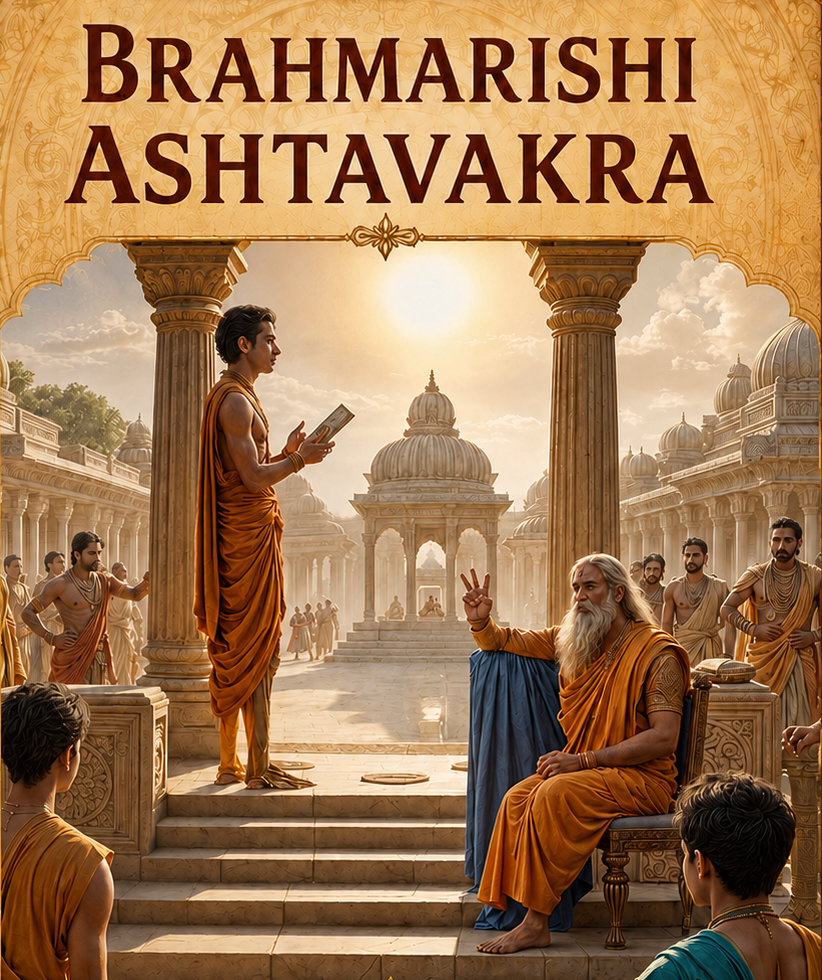
Other names: Aṣṭāvakra. Son of Kahoda/Kahola and Sujata, daughter of Uddalaka. While still in the womb he corrected his father’s Vedic recitation and was cursed to be born bent in eight places; later he defeated Vandi at King Janaka’s court, freed his father, and became associated with the Ashtavakra Gita.
Then Ashtavakra said, ‘One is not old because his head is gray. But the gods regard him as old who, although a child in years, is yet possessed of knowledge. The sages have not laid down that a man’s merit consists in years, or gray hair, or wealth, or friends. To us he is great who is versed in the Vedas. I have come here, O porter, desirous of seeing Vandin in the court. Go and inform king Janaka, who hath a garland of lotuses on his neck, that I am here. Thou shalt to-day see me enter into a dispute with the learned men, and defeat Vandin in a controversy. And when others have been silenced, the Brahmanas of matured learning and the king also with his principal priests, bear witness to the superior or the inferior quality of m attainments.’ – The Mahabharata, Book 3: Vana Parva: Tirtha-yatra Parva: Section CXXXIII
“The king said, ‘He alone is a truly learned man who understandeth the significance of the thing that hath thirty divisions, twelve parts twentyfour joints, and three hundred and sixty spokes.’ Ashtavakra said, ‘May that ever-moving wheel that hath twentyfour joints, six naves, twelve peripheries, and sixty spokes protect thee! 1’ The king said, ‘Who amongst the gods beareth those two which go together like two mares (yoked to a car), and sweep like a hawk, and to what also do they give birth?’ Ashtavakra said, ‘May God, O king, forfend the presence of these two 2 in thy house; aye, even in the house of thine enemies. He who appeareth, having for his charioteer the wind, 3 begetteth them, and they also produce him.’ Thereupon the king said, ‘What is that doth not close its eyes even while sleeping; what is it that doth not move, even when born; what is it that hath no heart; and what doth increase even in its own speed?’ Ashtavakra said, ‘It is a fish 4 that doth not close its eye-lids, while sleeping; and it is an a egg 5 that doth not move when produced; it is stone 6 that hath no heart; and it is a river 7 that increase in its own speed.’” – The Mahabharata, Book 3: Vana Parva: Tirtha-yatra Parva: Section CXXXIII