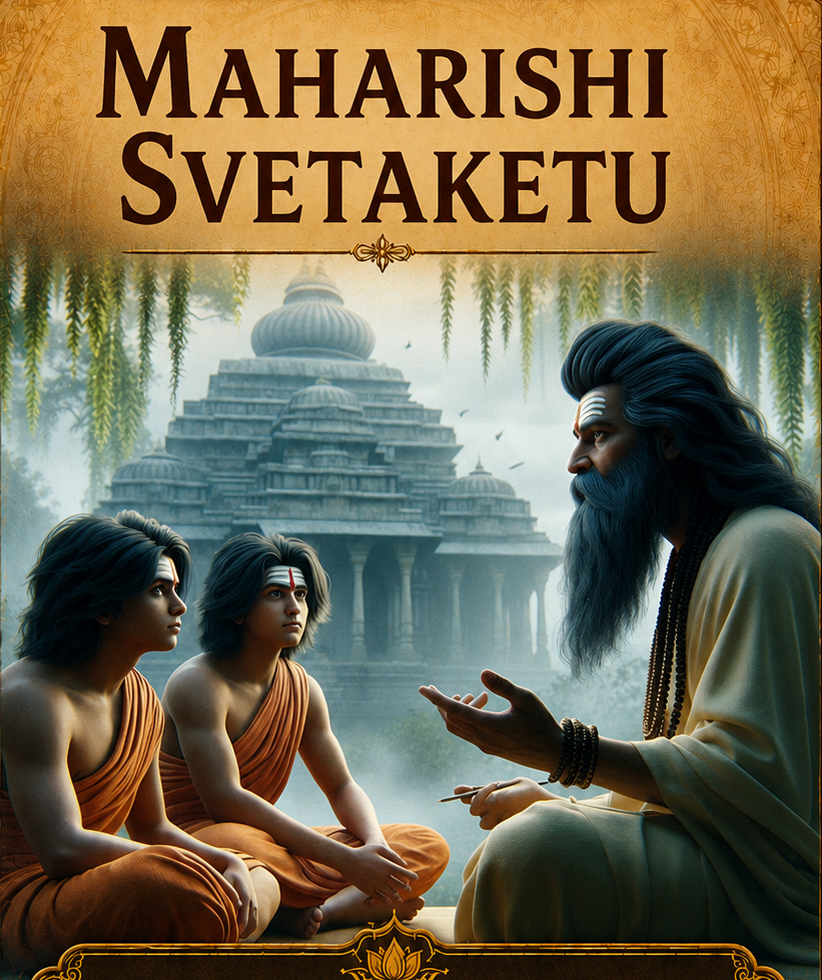
Maharishi Svetaketu
Other names: Swetaketu; Śvetaketu. Son of Uddalaka Aruni and a key student in the Chandogya Upanishad. After returning from study with pride in his learning, he receives from his father the profound teaching on the identity of the individual self with ultimate reality, expressed through “Tat Tvam Asi.”
“Great Rishi of the name of Uddalaka, who had a son named Swetaketu who also was an ascetic of merit. O thou of eyes like lotus-petals, the present virtuous practice hath been established by that Swetaketu from anger. Hear thou the reason. One day, in the presence of Swetaketu’s father a Brahmana came and catching Swetaketu’s mother by the hand, told her, ‘Let us go.’ Beholding his mother seized by the hand and taken away apparently by force, the son was greatly moved by wrath. Seeing his son indignant, Uddalaka addressed him and said, ‘Be not angry. O son! This is the practice sanctioned by antiquity. The women of all orders in this world are free, O son; men in this matter, as regards their respective orders, act as kine.’ The Rishi’s son, Swetaketu, however, disapproved of the usage and established in the world the present practice as regards men and women. It hath been heard by us, O thou of great virtue, that the existing practice dates from that period among human beings but not among beings of other classes.” – The Mahabharata, Book 1: Adi Parva: Sambhava Parva: Section CXXII
“O Svetaketu, my dear boy! You cannot be separated from That; you cannot stand outside this Being. As everything has come from that, you too have come from That. By the triplicated process of the elements your body has been formed, and everything that you are individually is a shape taken by that Being through the triplication of the three elements. So what you call ‘yourself’ or ‘myself’ or anything, refers to the Self and is a shape or form taken by the Being, and these shapes in turn cannot stand outside the Being. That is the Self of all Beings, and therefore, naturally you too are that. You cannot stand outside it, or external to it, or different from it. That is your Self; you yourself are That. O Svetaketu, the great conclusion to which you come by the analysis of the three elements is the existence of pure Being as the background of all that exists.” So says Uddalaka… ‘O Svetaketu, you are That,” instructs the father, Uddalaka. “Please explain further,” says the boy. He is not satisfied. “I shall explain to you further,” replies the father’”- Section 9, Chandogya Upanishad (obtained from Swami Krishnanda Divine Life Society)