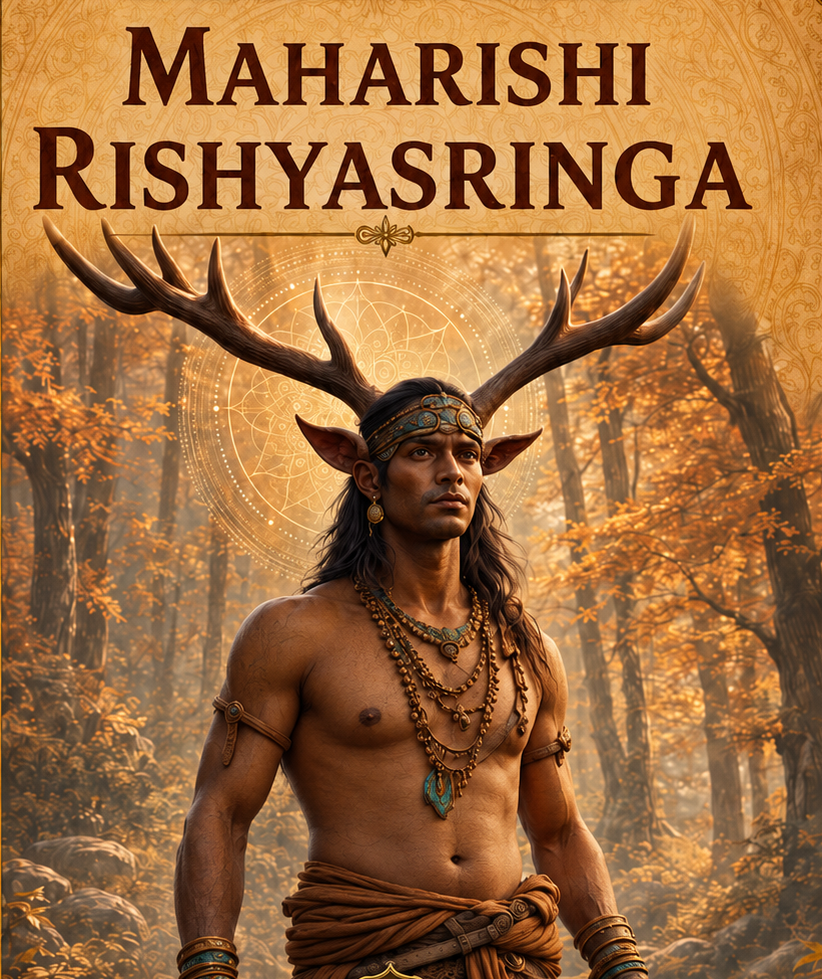
Maharishi Rishyasringa
Other names: Ṛṣyaśṛṅga; Rishyashringa; Rishyasringar. Son of the sage Vibhandaka; his unusual birth from a deer and the horn on his forehead gave him the name “deer-horned.” Raised in isolation in the forest, he later brought rain to Anga, married Shanta, and is remembered for performing the Putreshti sacrifice for King Dasharatha.
“O ruler of the earth! Send for Rishyasringa, the son of a saint, resident of the forest knowing nothing of the female sex, and always taking delight in simplicity. O king! If he, great in the practice of penances, should show himself in thy territory, forthwith rain would be granted by the heavens, herein I have no doubt at all…
Then the king of Anga convened a meeting of his ministers, proficient in giving counsel. he at last settled a plan (for gaining his object).
And then he sent for a number of courtesans, women of the town, clever in everything. ‘Ye lovely women! Ye must find some means to allure, and obtain the confidence of the son of the saint–Rishyasringa, whom ye must bring over to my territory.’ And those same women, on the one hand afraid of the anger of the king and on the other, dreading a curse from the saint, became sad and confounded, and declared the business to be beyond their power. One, however, among them–a hoary woman, thus spake to the king, ‘O great king! him whose wealth solely consists in penances, I shall try to bring over here. Thou wilt, however, have to procure for me certain things, in connection with the plan. In that case, I may be able to bring over the son of the saint–Rishyasringa.’ Thereupon the king gave an order that all that she might ask for should be procured. And he also gave a good deal of wealth and jewels of various kinds. And then, O Lord of the earth, she took with herself a number of women endowed with beauty and youth, and went to the forest without delay.” – – The Mahabharata, Book 3: Vana Parva: Tirtha-yatra Parva: Section CX
“son of Kasyapa had gone out to gather fruits, then that very courtesan came again to tempt Rishyasringa in the manner described above. And as soon as Rishyasringa had her in sight, he was glad and hurriedly rushing towards him said, ‘Let us go to thy hermitage before the return of my father.’ Then, O king! those same courtesans by contrivances made the only son of Kasyapa enter their bark, and unmoored the vessel. And by various means they went on delighting him and at length came to the side of Anga’s king….
The king, however, kept that only son of Vibhandaka within that part of the palace destined for the females when of a sudden he beheld that rain was poured by the heavens and that the world began to be flooded with water. And Lomapada, the desire of his heart fulfilled, bestowed his daughter Santa on Rishyasringa in marriage.”- The Mahabharata, Book 3: Vana Parva: Tirtha-yatra Parva: Section CXIII