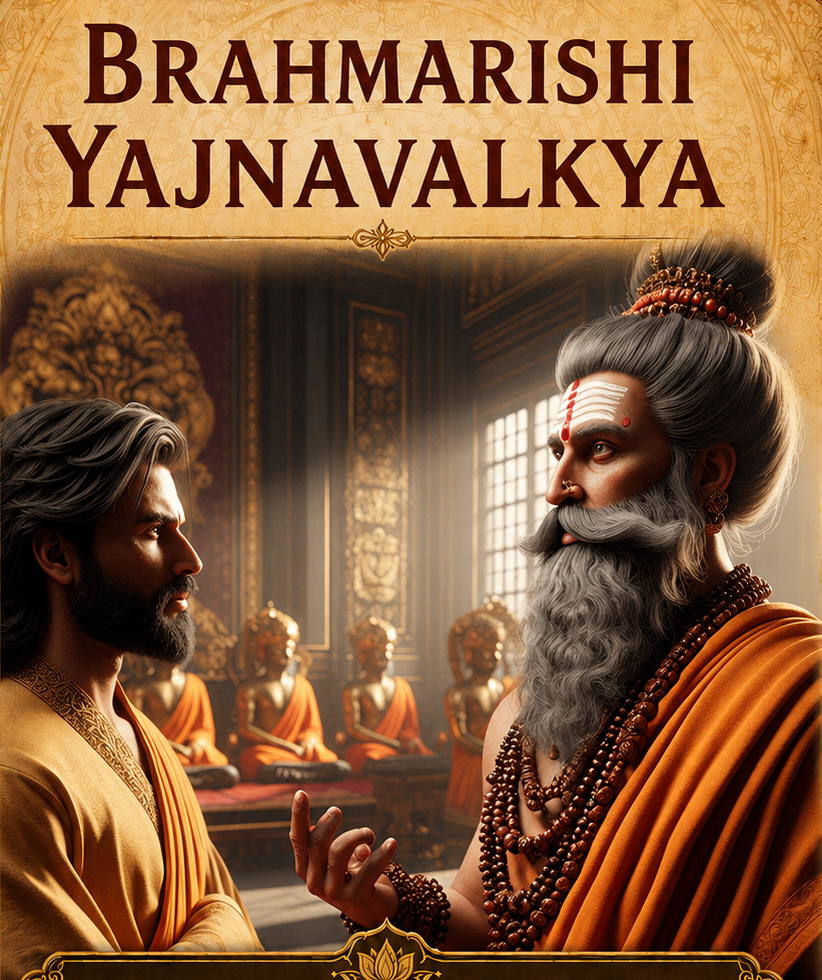
Brahmarishi Yajnavalkya
Other names: Yājñavalkya. A profound Vedic sage and philosopher, described in Purana tradition as spending much of his life at the court of King Janaka, where he also served as priest. He is closely associated with the Brihadaranyaka Upanishad, the Shukla Yajurveda tradition, and teachings on Atman, Brahman, and liberation.
“’Yajnavalkya said, These three, O foremost of men, (viz., Sattwa, Rajas, and Tamas), are the attributes of Prakriti. These attach to all things of the universe and always inhere to them. The Unmanifest Purusha endued with the six Yoga attributes transforms himself by himself into hundreds and thousands and millions and millions of forms (by embracing these three attributes). Those that are conversant with the science of Adhyatma, say that unto the attribute of Sattwa is assigned a high, unto Rajas a middling, and unto Tamas, a low place in the universe. By the aid of unmixed righteousness one attains to a high end (viz., that of the deities or other celestial beings). Through righteousness mixed with sin one attains to the status of humanity. While through unmixed sin one sinks into a vile end (by becoming an animal or a vegetable etc.).” – The Mahabharata, Book 12: Santi Parva: Section CCCXV
“I inculcated this science treating of Prakriti and Purusha. Indeed, this whole universe is Brahma. From the mouth of Brahma sprung the Brahmanas; from his arms, sprung the Kshatriyas; from his navel, the Vaisya; and from his feet, the Sudras. All the orders, (having sprung in this way) should not be regarded as pilfering from one another. Impelled by Ignorance, all men meet with death and attain, O king, to birth that is the cause of acts. 2 Divested of Knowledge, all orders of men, dragged by terrible Ignorance, fall into varied orders of being due to the principles that flow from Prakriti. For this reason, all should, by every means, seek to acquire Knowledge. I have told thee that every person is entitled to strive for its acquisition. One that is possessed of Knowledge is a Brahmana. Others, (viz., Kshatriyas and Vaisyas and Sudras) are possessed of knowledge. Hence, this science of Emancipation is always open to them all. This, O king has been said by the Wise. The questions thou hadst asked me have all been answered by me agreeably to the truth. Do thou, therefore, cast off all grief? Go thou to the other end of this enquiry. Thy questions were good. Blessings on thy head for ever!” – The Mahabharata, Book 12: Santi Parva: Section CCCXIX