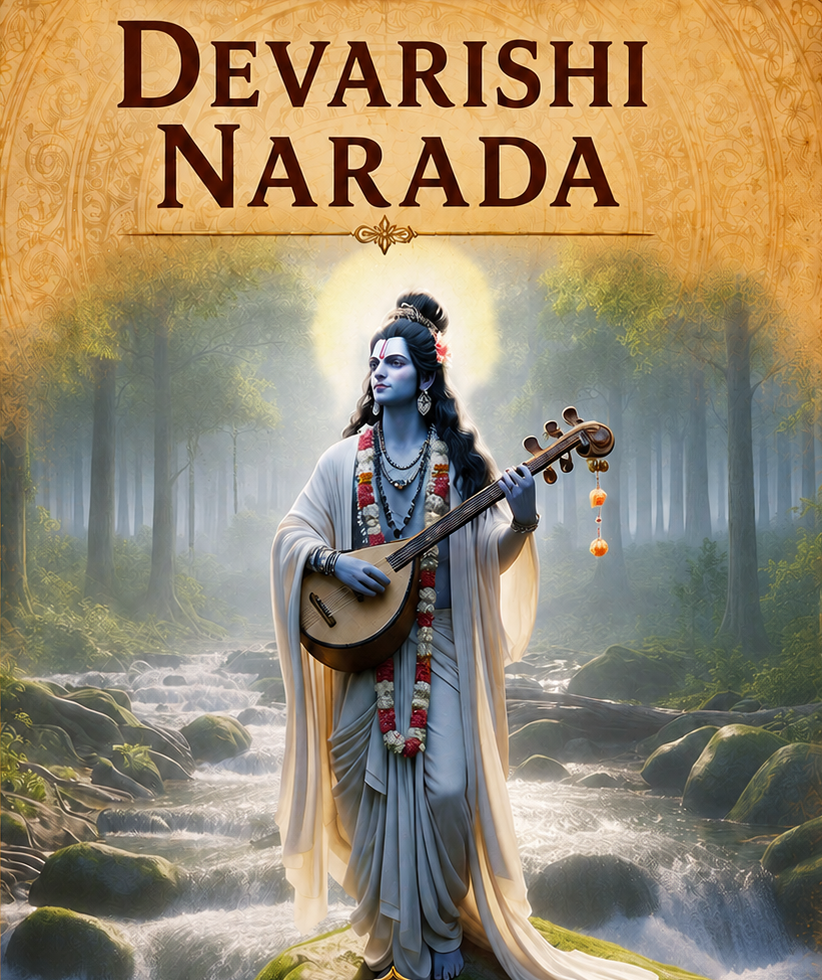
Devarishi Narada
Other names: Narada Muni; Nārada. A mind-born son of Brahma and celebrated Devarishi who moves through the three worlds as a messenger between Devas, sages, kings, and heroes. He is renowned as a great devotee of Vishnu, a master of music and the vina/tambura, and a catalytic figure whose interventions set major divine narratives in motion.
“O bull of the Bharata race, those kings also that yield up their lives without turning their backs on the field of battle attain to the mansion of Indra and live in joy with him. Those again that yield up their bodies after severe ascetic penances also attain to the same region and shine brightly there for ages. O king of the Kuru race, O son of Kunti, thy father Pandu, beholding the good fortune of Harischandra and wondering much thereat, hath told thee something. Knowing that I was coming to the world of men, he bowed unto me and said,–Thou shouldst tell Yudhishthira, O Rishi, that he can subjugate the whole Earth inasmuch as his brothers are all obedient to him. And having done this let him commence the grand sacrifice called Rajasuya. He is my son; if he performeth that sacrifice, I may, like Harischandra, soon attain to the region of Indra, and there in his Sabha pass countless years in continuous joy. I told him in reply,–O King, I shall tell thy son all this, if I go to the world of man. I have now told thee what he said, O tiger among men. Accomplish then, O son of Pandu, the desires of thy father. If thou performest that sacrifice, thou shall then be able to go, along with thy deceased ancestors, into the same region that is inhabited by the chief of the immortals. O bull of the Bharata race, those kings also that yield up their lives without turning their backs on the field of battle attain to the mansion of Indra and live in joy with him. Those again that yield up their bodies after severe ascetic penances also attain to the same region and shine brightly there for ages. O king of the Kuru race, O son of Kunti, thy father Pandu, beholding the good fortune of Harischandra and wondering much thereat, hath told thee something. Knowing that I was coming to the world of men, he bowed unto me and said,–Thou shouldst tell Yudhishthira, O Rishi, that he can subjugate the whole Earth inasmuch as his brothers are all obedient to him. And having done this let him commence the grand sacrifice called Rajasuya. He is my son; if he performeth that sacrifice, I may, like Harischandra, soon attain to the region of Indra, and there in his Sabha pass countless years in continuous joy. I told him in reply,–O King, I shall tell thy son all this, if I go to the world of man. I have now told thee what he said, O tiger among men. Accomplish then, O son of Pandu, the desires of thy father. If thou performest that sacrifice, thou shall then be able to go, along with thy deceased ancestors, into the same region that is inhabited by the chief of the immortals.”
– The Mahabharata, Book 2: Sabha Parva: Lokapala Sabhakhayana Parva: Section XII
“Vaishampayana said, “There was a rishi of abundant energy and great fame, named Kuni-Garga. That foremost of ascetics, having practised the austerest of penances, O king, created a fair-browed daughter by a fiat of his will. Beholding her, the celebrated ascetic Kuni-Garga became filled with joy. He abandoned his body, O king, and then went to heaven. That faultless and amiable and fair-browed maiden, meanwhile, of eyes like lotus petals continued to practise severe and very rigid penances. She worshipped the pitris and the gods with fasts. In the practice of such severe penances a long period elapsed. Though her sire had been for giving her away to a husband, she yet did not wish for marriage, for she did not see a husband that could be worthy of her. Continuing to emaciate her body with austere penances, she devoted herself to the worship of the pitris and the gods in that solitary forest. Although engaged in such toil, O monarch, and although she emaciated herself by age and austerities, yet she regarded herself happy. At last when she (became very old so that she) could no longer move even a single step without being aided by somebody, she set her heart upon departing for the other world. Beholding her about to cast off her body, Narada said unto her, ‘O sinless one, thou hast no regions of blessedness to obtain in consequence of thy not having cleansed thyself by rite of marriage! O thou of great vows, we have heard this in heaven! Great hath been thy ascetic austerities, but thou hast no claim to regions of blessedness!’ Hearing these words of Narada, the old lady went to a concourse of rishis and said, ‘I shall give him half my penances who will accept my hand in marriage!’ After she had said those words, Galava’s son, a rishi, known by the name of Sringavat, accepted her hand, having proposed this compact to her, ‘With this compact, O beautiful lady, I shall accept thy hand, that thou shalt live with me for only one night!’ Having agreed to that compact, she gave him her hand. Indeed, Galava’s son, according to the ordinances laid down and having duly poured libations on the fire, accepted her hand and married her. On that night, she became a young lady of the fairest complexion, robed in celestial attire and decked in celestial ornaments and garlands and smeared with celestial unguents and perfumes. Beholding her blazing with beauty, Galava’s son became very happy and passed one night in her company.” – The Mahabharata, Book 9: Shalya Parva: Section 52
“Then the two great rishis, Narada, who is the soul of every creature, and the grandsire of all the Bharata princes (Vyasa), beholding those two weapons scorching the three worlds, showed themselves there. The two rishis sought to pacify the two heroes Ashvatthama and Dhananjaya. Conversant with all duties and desirous of the welfare of all creatures, the two sages, possessed of great energy, stood in the midst of those two blazing weapons. Incapable of being overwhelmed by any force, those two illustrious rishis, placing themselves between the two weapons, stood like two blazing fires. Incapable of being checked by any creature endued with life, and adorned by the gods and danavas, they two acted in this way, neutralising the energy of the two weapons and doing good to all the world. The two rishis said, “Those great car-warriors who have fallen in this battle were acquainted with diverse kinds of weapons. They, however, never shot such a weapon upon human beings. What act of rashness is this, ye heroes, that ye have done?” – The Mahabharata, Book 10: Sauptika Parva: Section 14