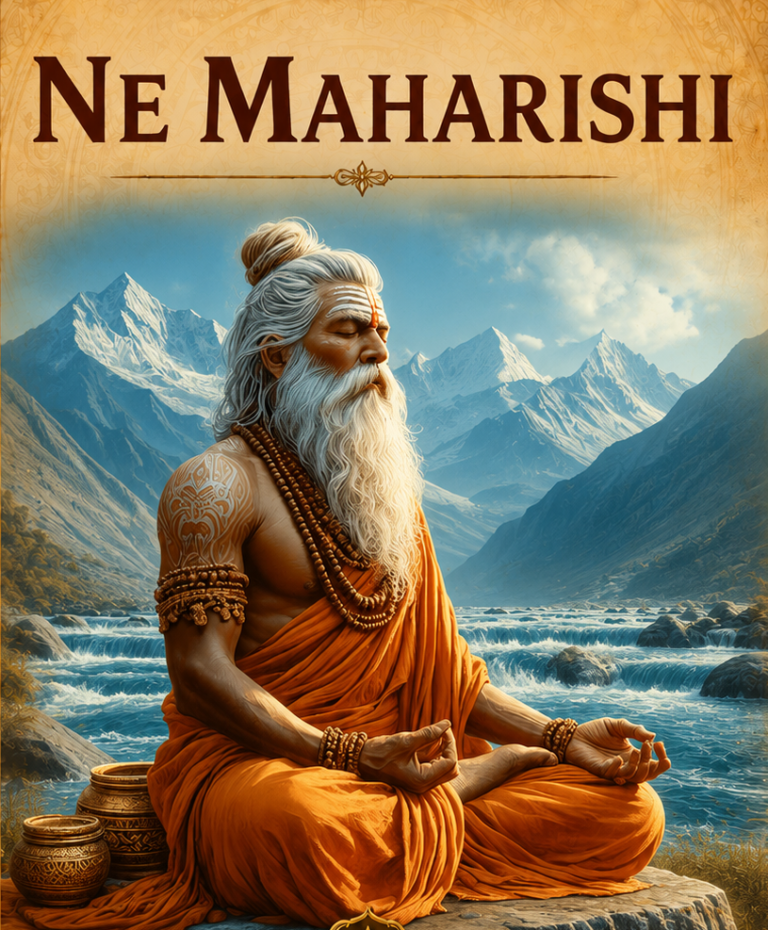

Maharishi Vibhandaka
Other names: Vibhāṇḍaka. Son of Kashyapa and father of Rishyasringa. His son’s extraordinary birth through a deer and his isolated upbringing in the forest form one of the Mahabharata’s most unusual origin stories, emphasizing austerity, restraint, and the power of tapas.
“When the great saint Vibhandaka should enquire of you about his son, ye must join your palms and say to him that these cattle, and these ploughed fields belong to his son and that ye are his servants, and that ye are ready to obey him in all that he might bid.’ Now the saint, whose wrath was fierce, came to his hermitage, having gathered fruits and roots and searched for his son. But not finding him he became exceedingly wroth. And he was tortured with anger and suspected it to be the doing of the king. And therefore, he directed his course towards the city of Champa having made up his mind to burn the king, his city, and his whole territory. And on the way he was fatigued and hungry, when he reached those same settlements of cowherds, rich with cattle. And he was honoured in a suitable way by those cowherds and then spent the night in a manner befitting a king. And having received very great hospitality from them, he asked them, saying, ‘To whom, O cowherds, do ye belong?’ Then they all came up to him and said, ‘All this wealth hath been provided for thy son.’ At different places he was thus honoured by that best of men, and saw his son who looked like the god Indra in heaven. And he also beheld there his daughter-in-law, Santa, looking like lightning issuing from a (cloud). And having seen the hamlets and the cowpens provided for his son and having also beheld Santa, his great resentment was appeased. And O king of men! Vibhandaka expressed great satisfaction with the very ruler of the earth. And the great saint, whose power rivalled that of the sun and the god of fire, placed there his son, and thus spake, ‘As soon as a son is born to thee, and having performed all that is agreeable to the king, to the forest must thou come without fail.’ And Rishyasringa did exactly as his father said, and went back to the place where his father was.” – The Mahabharata, Book 3: Vana Parva: Tirtha-yatra Parva: Section CXIII